|
|
Writing for
this Unit:
SYP Unit 15
Life in the UAE in the past
|
Grammar for
this Unit:
"Used To" Habitual
Past
Tag Questions
|
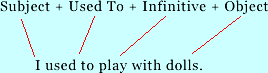
"Used To" shows Past Habit:
( Subject + Used To + Infinitive Verb + Object)
|
"Used To"
shows a habit in the past. It does not happen anymore.
Think about some things you did s a child. Do
you still do all of them now as adults? Probably not. Let's
look at an example.
When she was a child, she used
to play with dolls.
(but she doesn't anymore)
This girl played with dolls as a habit in the past.
She did it many, many times.
The girl grew up and is now an adult. She doesn't play with
dolls now.
We also use this to show that somethng in the past
was a fact, but is not now.
Example: Abdulla used
to drink coffee. (he doesn't now)
|
 In the Past
|
 In the Past
 |
|
|
|
On the left is the sentence
structure, how we form the sentence using "used
to".
|
|
|
"Used To" is different that the simple past because it
shows a habit.
Simple past shows something that happened before,
but maybe it happened only one or two times, not many like a habit. Let's
look at an example.
|
|
I used
to go to the beach every summer when I was a child. |
Used To
|
Habit
|
| I went
to the beach once when I was 11 years old. |
Simple Past
|
One Time
|
|
|
"Used to" or "Use To"?
We use "Used
To" for positive
statements.
We use "Use
To" for negative
statements and questions.
|
For example: I used to be in
Semester 3.
For example: I didn't use
to do my homework.
|
|
How do we use "Use To" in questions?
( Did + Subject + Use To + Infinitive)
Like other past tense yes/
no questions you have learned about, we use "did".
|
|
|
The example on the right is for information
questions.
(Question Word + Did + Use To + Infinitive)
|

|
Click for more help with "used
to".
Tag Questions:
|
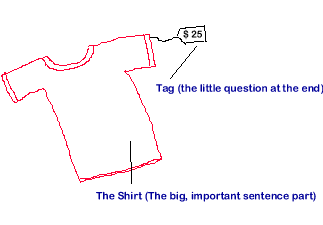
Tag questions are sentences, with
a very small question put on the end, like the price tag you see
on a piece of clothing at a shop.
|
|
|
|
|
In tag questions, the most important thing is the
bigger sentence part. This is the part we answer.
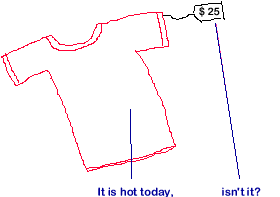
If the sentence
part is positive, and the tag
is negative, we can expect
a positive answer.
Look at the example in the picture above. The sentence
is positive: "It is hot today"
The answer is negative: "isn't
it?" We expect the other person to agree with us:
"Yes, it is".
Look at this table for somemore examples:
|
Sentence
|
Tag
|
Expected Answer
|
|
(+) The sun is shinning,
|
isn't
it? (-)
|
(+) Yes, it is.
|
|
(-) It isn't expensive,
|
is it? (+)
|
(-) No, it isn't.
|
|
 
|