|
|
Writing for this Unit:
Describing Life in the UAE in the Future:
SYP Unit 15
Headway Workbook Unit Nine
|
Grammar for
this Unit:
"Will" For Predictions
First Conditional and Time Clauses
|
In the past semester, you used "will"
to show something for the future that was decided at the moment of speaking.
This semester, we are going to you "will" to show a prediction
for the future.
|
Will shows something
that you predict or think will be a
fact in the
future.
This is a prediction: You are not sure, but you
think it will probably happen.
For example: When I get my certificate,
I will get a good job.
For example: Everyone in Semester Four will
graduate from college.
|

|
Want to review "will
" some more? Click on the blue word.
|
We often use other words with the word "will"
to show how sure we are about a future thing.
|
It will
|
probably
|
happen.
|
Very Sure It Will
|
|
It
|
might
|
happen
|
About 50% Sure
|
|
It will
|
probably
|
not
happen
|
Very Sure It Will Not
|
Example one: The
UAE will probably be a world
leader in the Internet in 20 years.
Example two: I
might become a computer programmer
after I get my certificate.
Example three: There will
probably not be an earthquake in the UAE.
|
The First Conditional:
(If + Present Simple + will + Infinitive without "to")
|
The First Conditional
tells us about a possible future situation and what happens
if it comes true.
For Example: If
I don't study, I will
not pass my exams.
Now, let's look at this negative sentence
and compare it to the formula above.
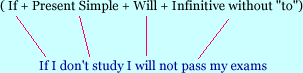
Let's look at another example. This
time, we will use a positive sentence.
|
If
I pass my exams, I will
get
my certificate.
|
|
|
If you want more information about the first
conditional, just click on the word. Click if you
just want to see a few examples
without the grammar rule again.
Time Clauses: If and When
|
You have just seen that "If"
shows that a result is possible to happen in the future if the condition
happens. So, it is still only a possibility. We are not sure
that the weather will be hot tomorrow.
|
"If
it is hot tomorrow, I will
go swimming."
|
She is not sure that
the weather will be hot, so she may not go swimming.
|
|
We can use "when"
to show that you are more certain you will do something because
you are sure the condition is going to happen.
|
|
"When
the weather is hot in June, I will
go swimming."
|
She she is sure that
it will be hot in Abu Dhabi in June!
|
|
 
|


