What's On Unit Eleven


Home | What's On! | Quiz Page | KCA Exam | Work Placement | Dictionary                                   Unit:   9  10  11  12


Writing for this Unit:

A book or film review
A short message or e-mail

Grammar for this Unit:

The Passive Voice


The Passive Voice 


The Passive Voice   (General Information)

In English, there are two types of sentences. The Active and the Passive.

                            (Active)                                                                                                  (Passive
People grow dates in the UAE.
Date Palm
Dates are grown in the UAE by people.

An active sentence means that we see subject (people) before the verb (grow).  We use this when it is important to know who did the action.

We use a passive sentence when the action is more important than the people who did the action. The object (dates) comes before the verb.

Often the person who does the action is not even in the senetnce.    The "by-phrase" is deleted.

Dates are grown in the UAE.
"by people" is deleted.  We know people did it.  Cats don't grow dates, do they?  No, people grow them.  It is not neccessary to say so.  We know it must be people.


We can also delete the "by phrase" when we want to hide the person who did the action.

Huda broke the TV during the break.
Oooops!  I broke it!
The TV was broken when we came to class.

Both sentences are true.  If the college director asked about the TV, which answer would you give?


Forming the Passive:

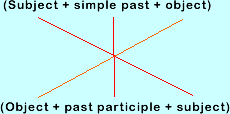
To form the passive voice, the subject (Mariam) changes places with the object (the cake). The verb (ate) is changed to the past participle.

The two diagrams show how this is done.


Click to a see a list of irregular  Past Participle  verbs or look in your Headway books on page 141.
Click for more help with the   Passive Voice  or look on page 129 in Headway. Click to see a chart of how the passive is used in all English verb tenses.


© Arthur Rush: April, 2001